Launch offer — valid today only

📄 Digital book in PDF · read it on your phone or print it

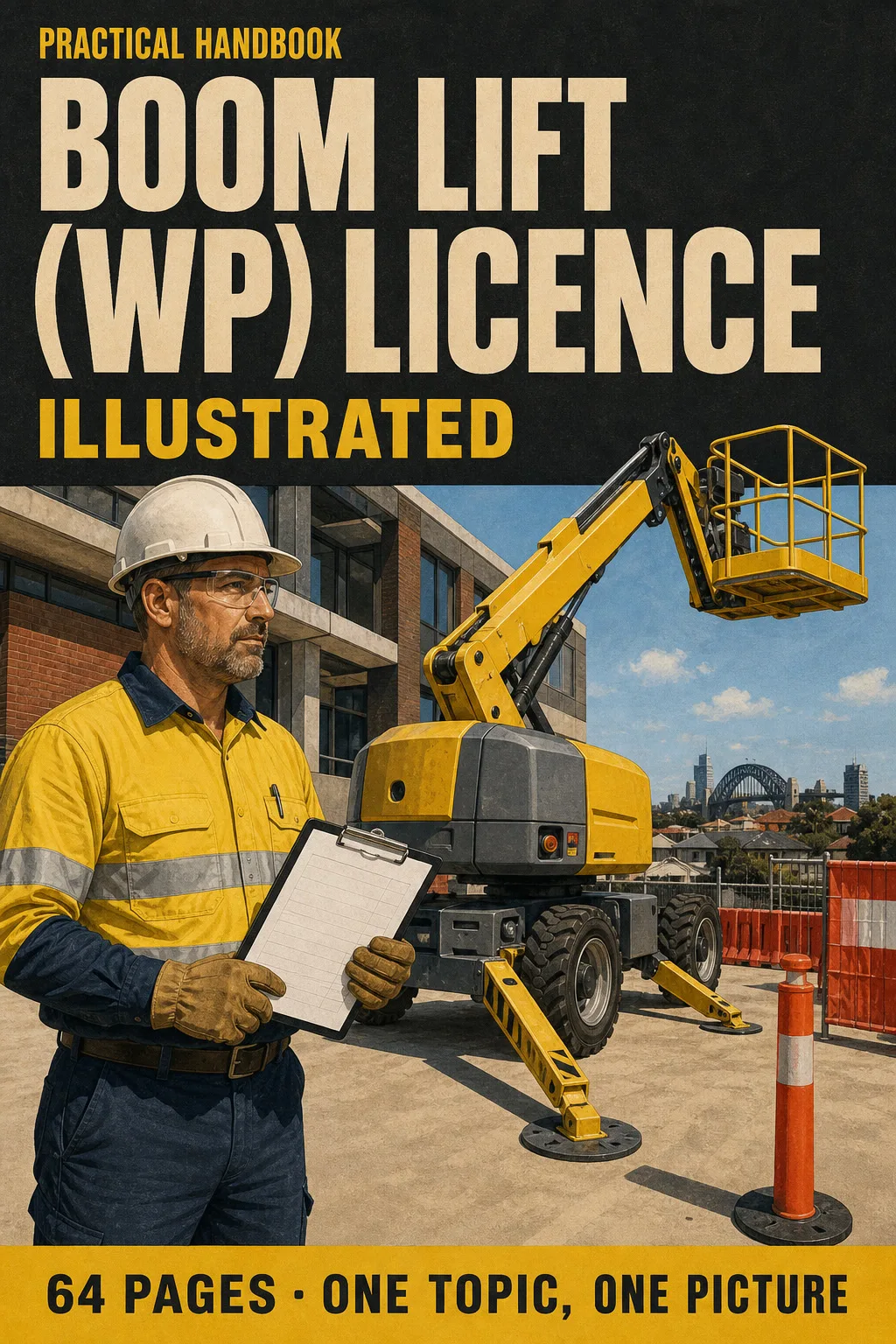
The Boom Lift WP Licence in Drawings The Pre-Start, the Load Chart and the Rescue Plan, One Drawn Page Each

Pre-start checks, the load chart, ground conditions, outriggers and pads, power line distances, fall restraint, the rescue plan and emergency lowering. Each topic gets its own page: the drawing first, then what you need to remember. 64 illustrated pages.

START STUDYING THIS WAY

🔒 Secure checkout · PDF by email · 30-day guarantee

Every topic, its own pageEach check and limit drawn, with the explanation beside it
64 illustrated pages8 parts, from what a WP licence covers to the night before the assessment
Up-to-date sourcesModel WHS Regulations, unit TLILIC0005 and AS 2550.10
PDF by emailFormat

Look Inside the Book

Every page has one big drawing and a box with the steps and limits you need to know:

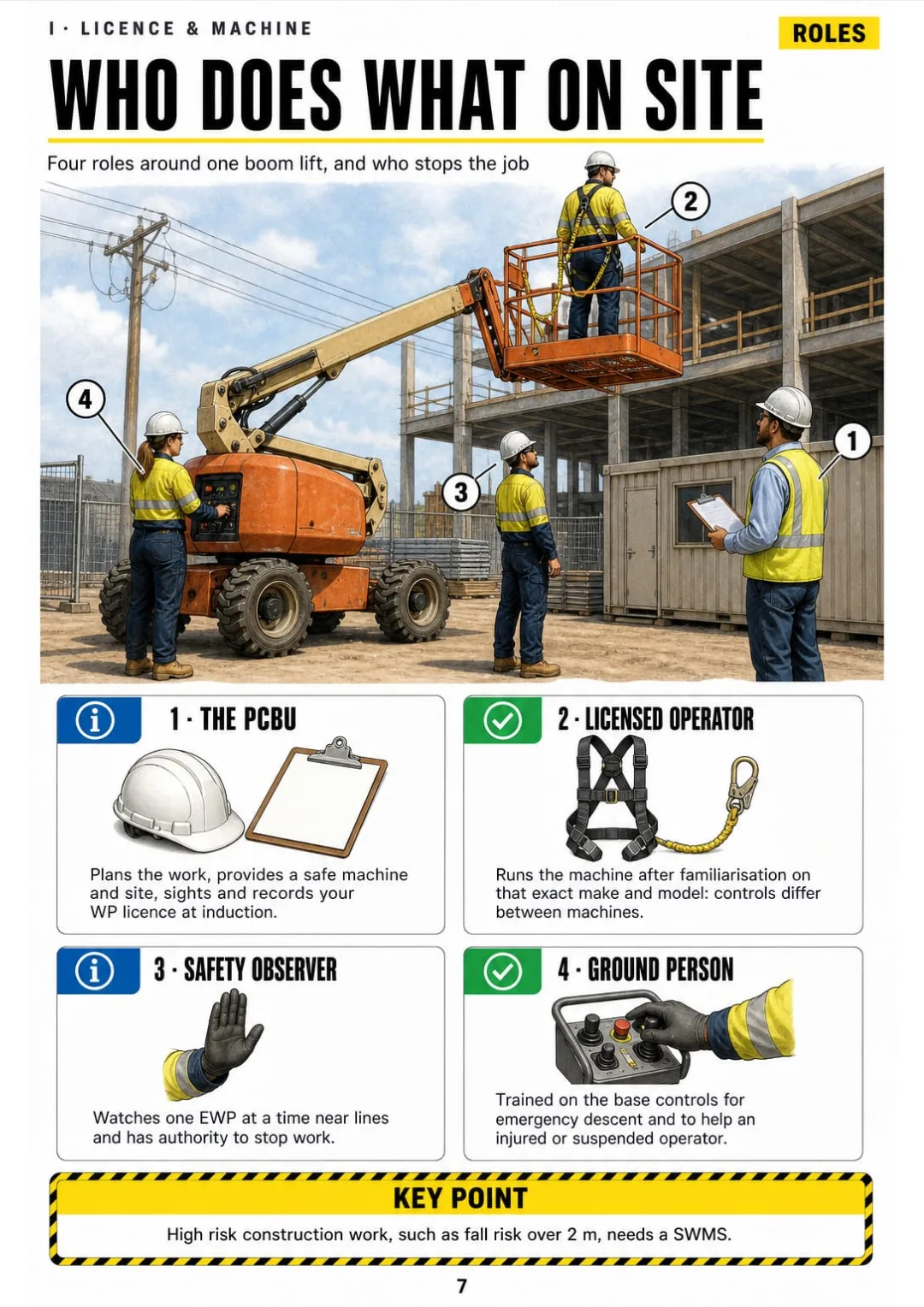
PCBU, operator, safety observer, ground person: who does what around the boom
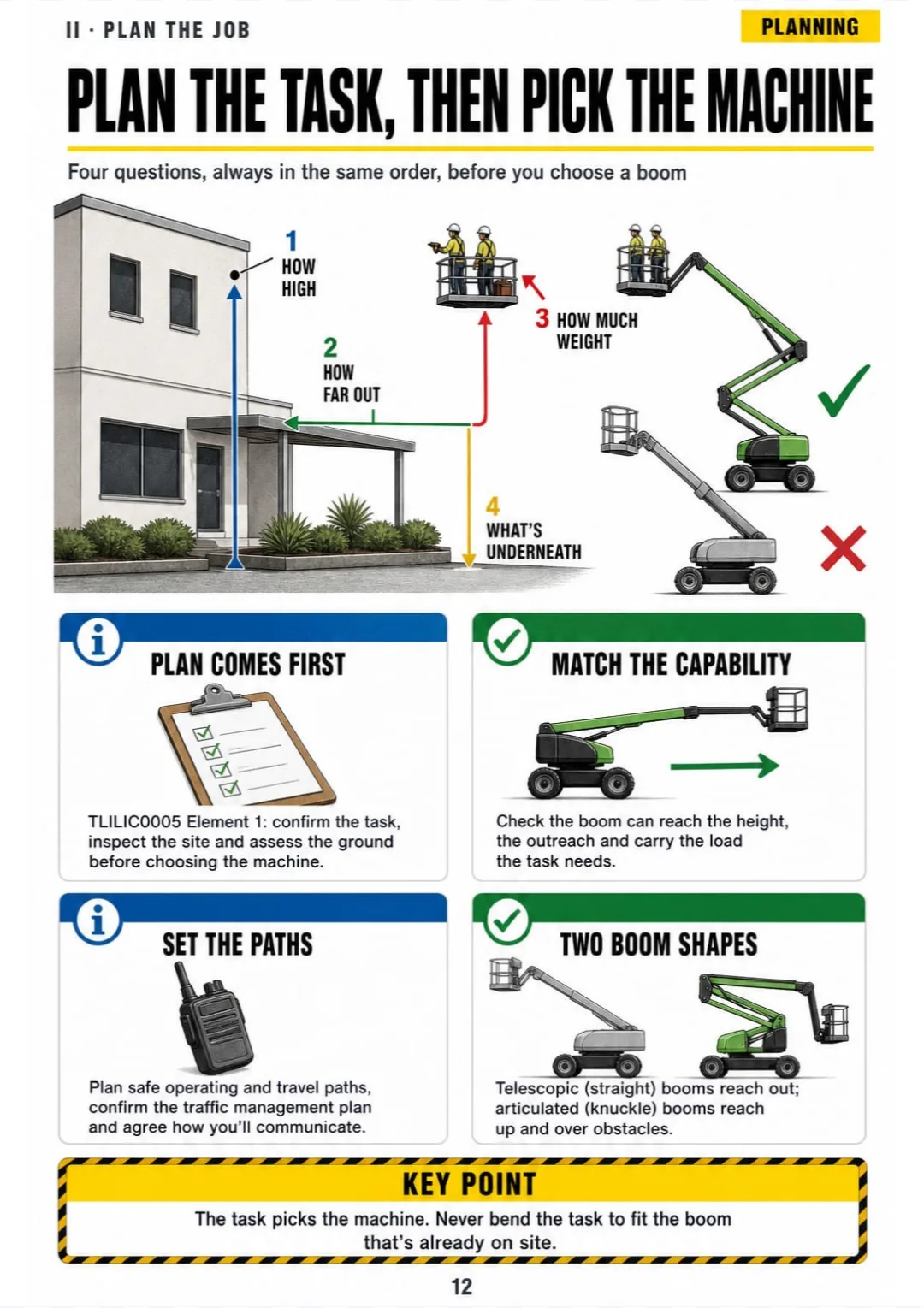
How high, how far out, how much weight, what's underneath: in that order.
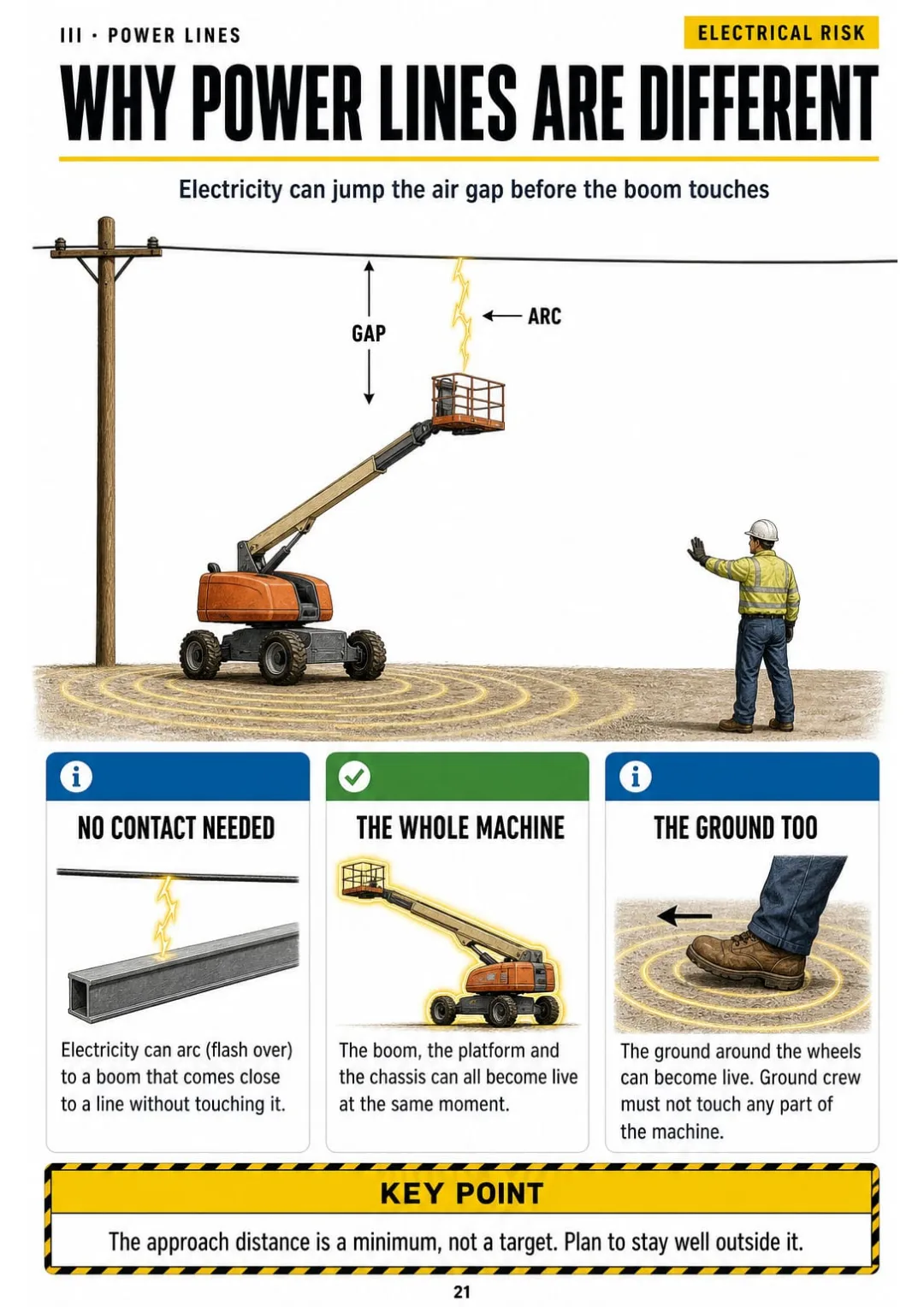
Arc across the gap, live machine, live ground: why you de-energise the line or keep your distance
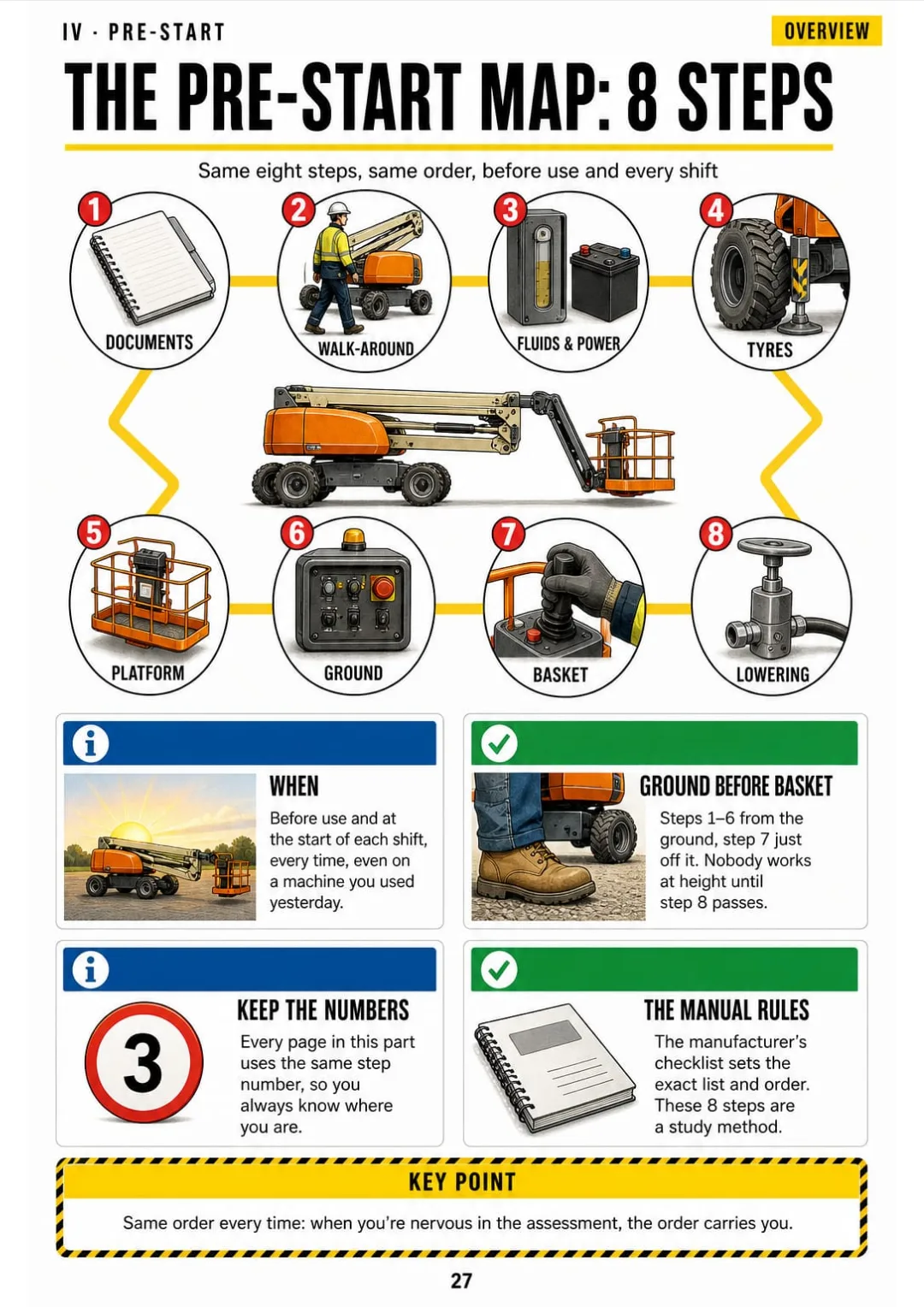
The whole pre-start on one page: 8 numbered steps, from documents to emergency lowering.
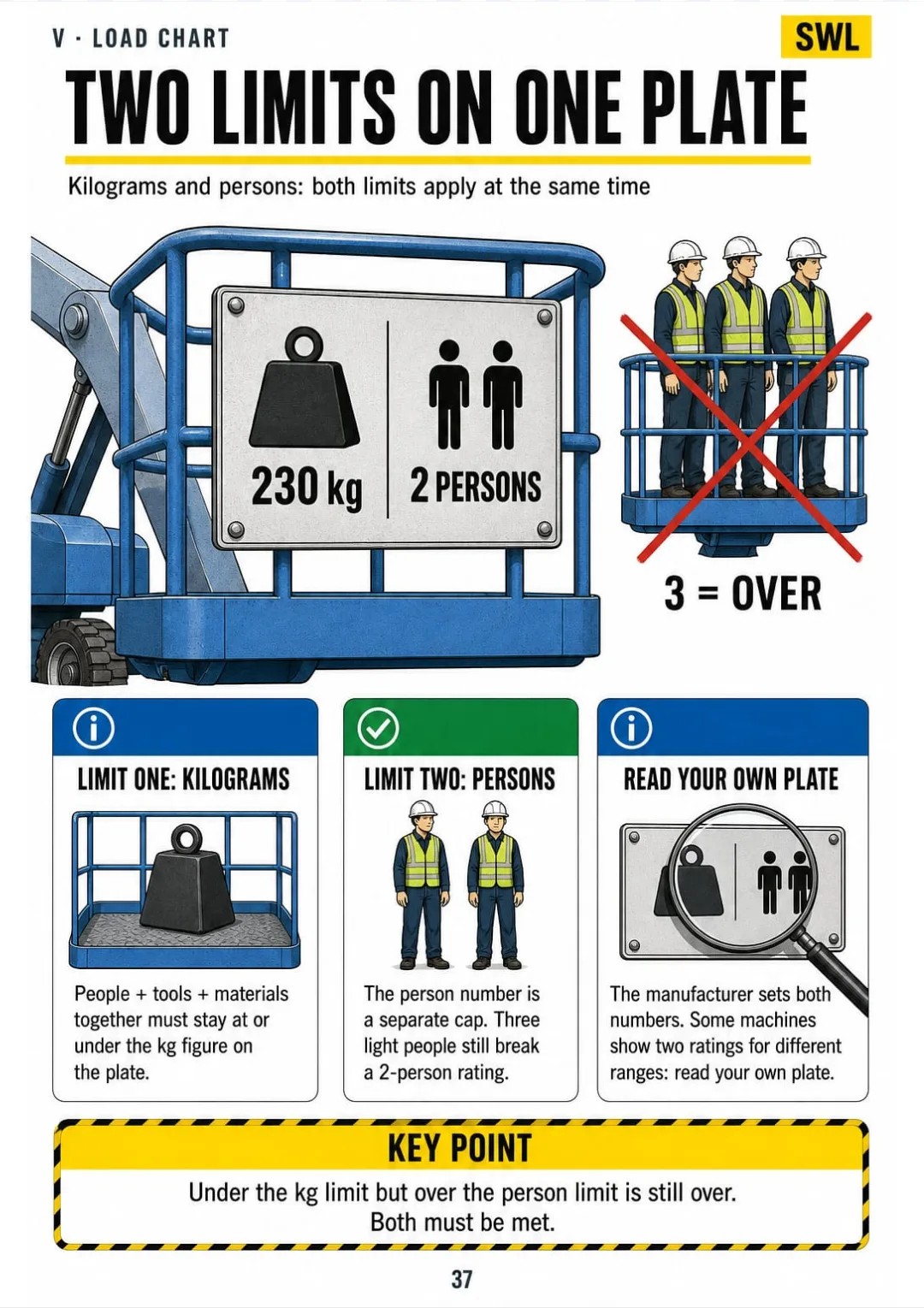
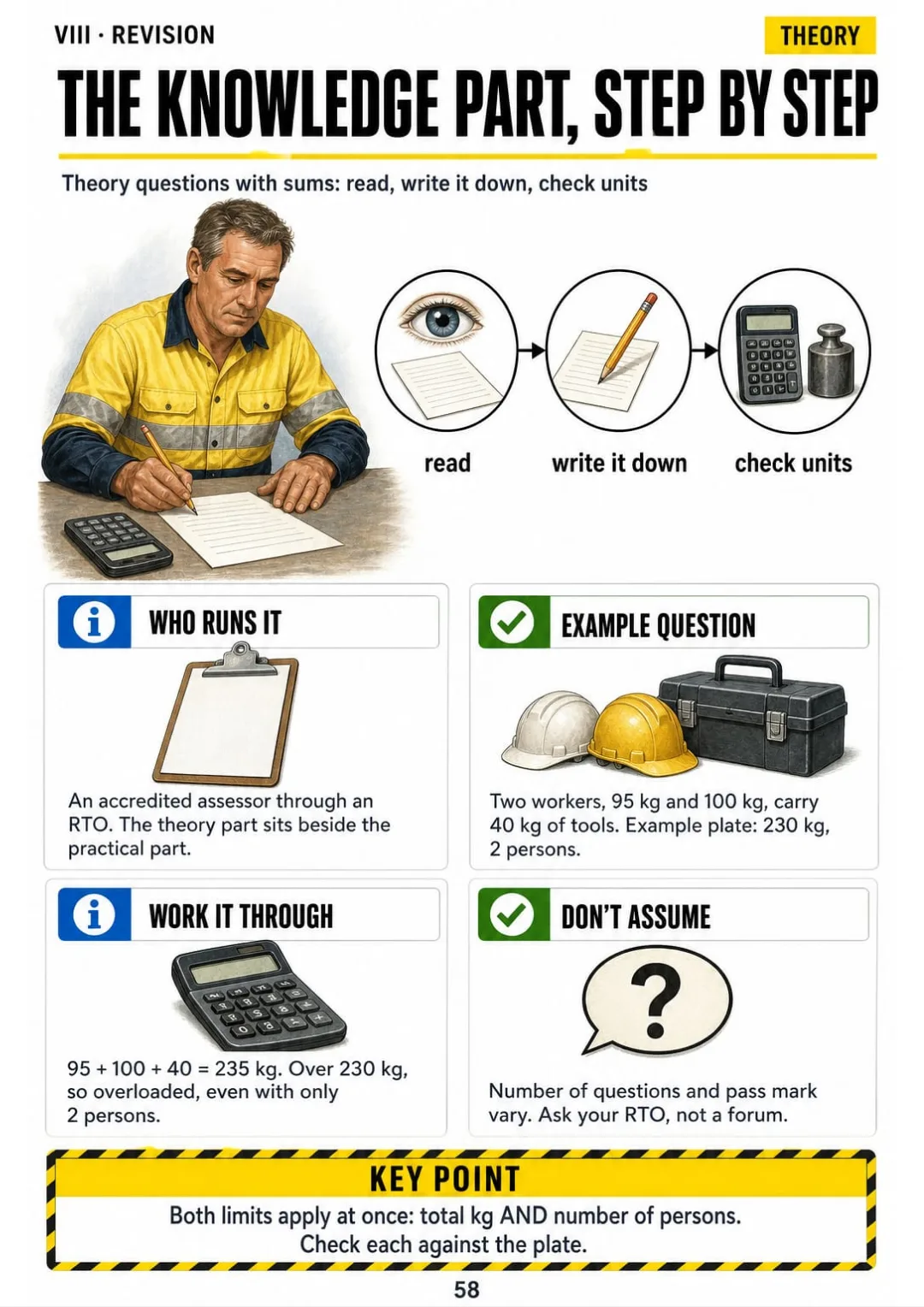
Example plate 230 kg and 2 persons: three light workers are still over the limit.
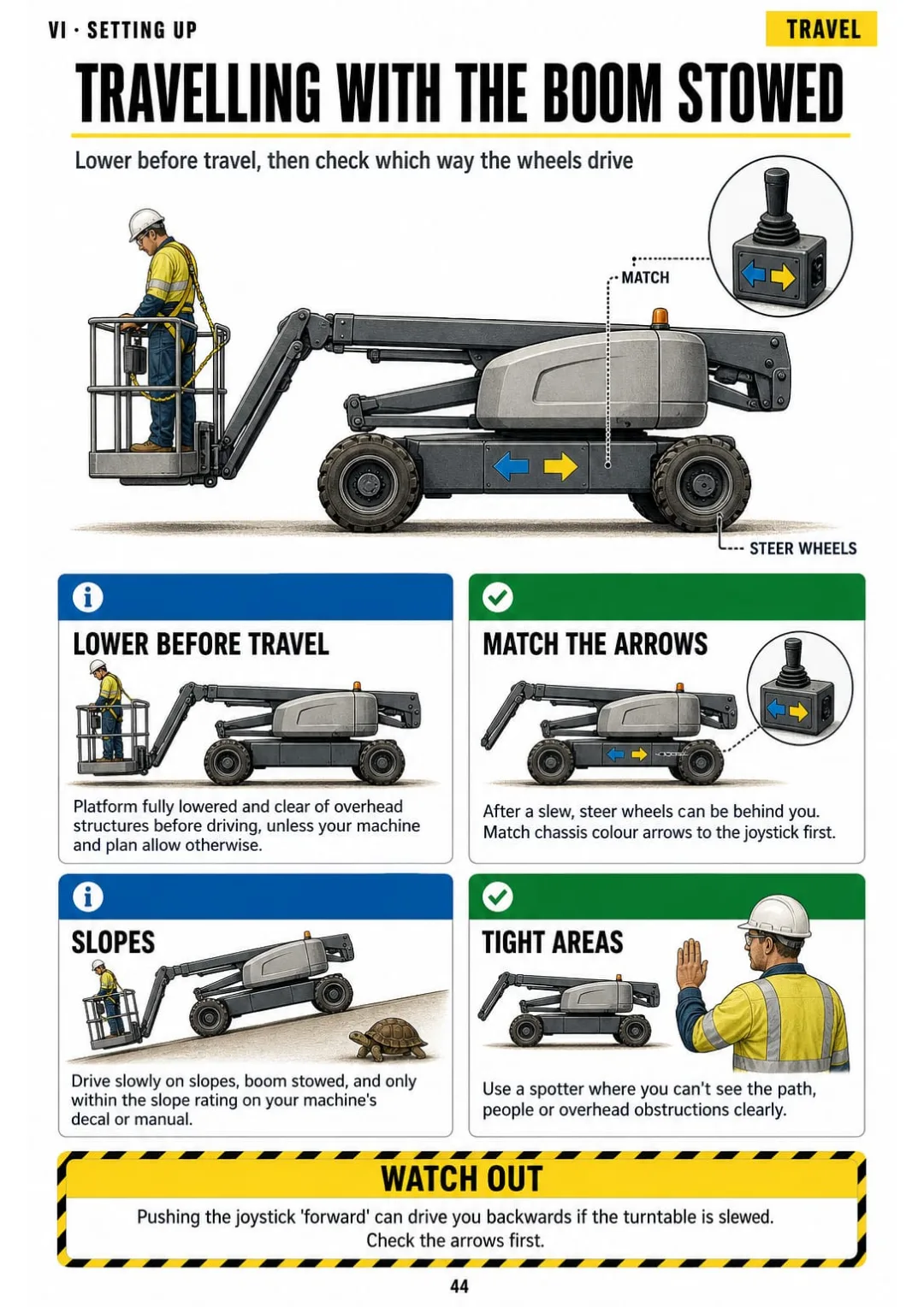
Boom stowed, colour arrows matched, slow on slopes, spotter in tight spots.
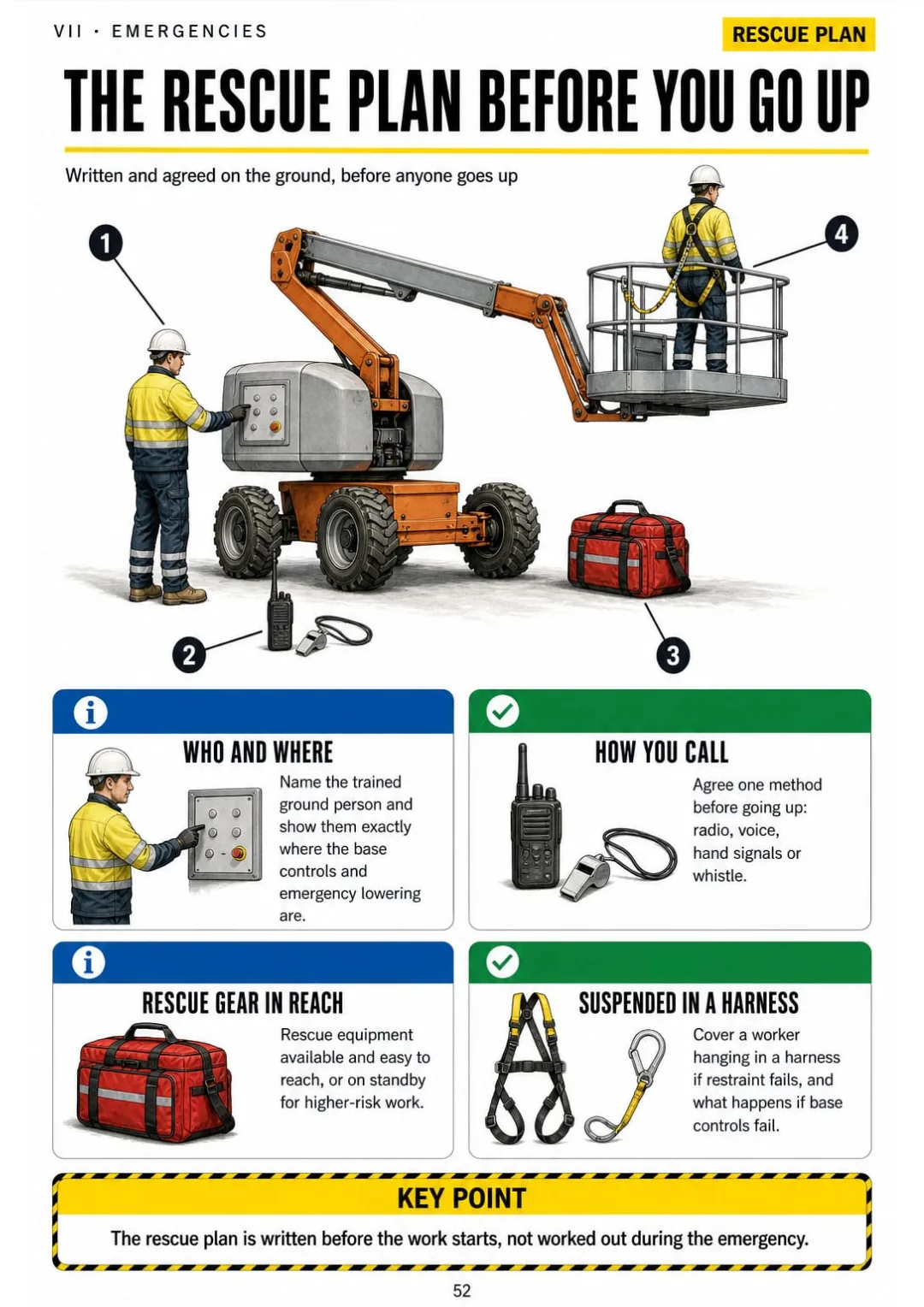
Ground person, emergency controls, call method, rescue gear: all agreed before the platform leaves the ground.
Worked example: 95 + 100 + 40 kg = 235 kg, over a 230 kg plate even with 2 persons

Swipe to see more →

These are real pages from the book. The table of contents is the full one: 8 parts and 60 topics.

The Problem Isn't You. It's How It Was Explained.

You're at the training yard, there's an overhead line drawn on the whiteboard, and the trainer asks: why isn't it enough to just keep the boom from touching it? You know the answer is in the manual somewhere.

The manual gives it three paragraphs on arcing, conductive paths and earth potential. Read at night after a full day on site, the words slide past and nothing sticks.

Arc across the gap, live machine, live ground: why you de-energise the line or keep your distance

In the book, that topic is one page. One drawing: the arc jumping across the gap, the machine going live, the ground around the wheels going live too. Next to it, the two options: get the line de-energised or keep your distance.

The same goes for the pre-start in 8 steps, the two limits on the data plate, outriggers and pads, the exclusion zone around the base and the rescue plan. Each one has its own page.

You look at the drawing, you understand why, and you answer the assessor without flicking back through the manual.

COMPARE FOR YOURSELF

The Same Topic, Two Ways to Study It

THIS
  • The manual: line after line after line
  • Task planning explained only in words
  • You walk into the assessment unsure
Prior to the selection of an elevating work platform, the operator shall undertake an assessment of the task requirements, having regard to the maximum working height required, the horizontal outreach necessary to access the work area, the combined mass of personnel, tools and materials to be carried on the platform, and the nature of the supporting surface together with any services located beneath or adjacent to the intended set-up position, in addition to any other site-specific factors identified during consultation.
FOR THIS
  • Task planning in one drawing
  • The four questions in a box, in order
  • You see it and you get it
How high, how far out, how much weight, what's underneath: in that order.
CONTENTS

Take a Look at the 8 Parts and 60 Topics

The licence and the machine, planning the job, power lines and services, the pre-start, the load chart and working envelope, setting up and operating, emergencies and rescue, and assessment-ready revision: 64 pages, all illustrated

IThe Licence and the Machine · pp. 5-11
  1. What a WP Licence Covers
  2. From Course to Licence Card
  3. Who Does What on Site
  4. Types of Boom Lift
  5. Parts of the Boom Lift, Named
  6. The Data Plate and the Manual
  7. Reading the Controls
IIPlan the Job Before You Start · pp. 12-20
  1. Plan the Task, Then Pick the Machine
  2. The Five Places Hazards Hide
  3. The Hierarchy of Control on a Boom Job
  4. Reading the Ground
  5. Outriggers and Pads
  6. Wind and Weather
  7. Overhead Structures and Crushing
  8. The Exclusion Zone Around the Base
  9. The Work Zone Layout, Drawn From Above
IIIPower Lines and Services · pp. 21-26
  1. Why Power Lines Are Different
  2. Approach Distances by Voltage
  3. Measuring Distance in Three Dimensions
  4. The Safety Observer Near Lines
  5. If the Boom Touches a Line
  6. Underground Services and Pits
IVThe Pre-Start, Always in the Same Order · pp. 27-36
  1. The Pre-Start Map
  2. Step 1: Documents and Logbook
  3. Step 2: The Walk-Around
  4. Step 3: Fluids and Power
  5. Step 4: Tyres, Wheels and Outriggers
  6. Step 5: The Platform
  7. Step 6: Ground Controls Test
  8. Step 7: Platform Controls Test
  9. Step 8: Test the Emergency Lowering
  10. When You Find a Defect
VLoad Chart and Working Envelope · pp. 37-43
  1. Safe Working Load in kg and in Persons
  2. Adding Up the Load: A Worked Example
  3. Restricted and Unrestricted Range
  4. The Working Envelope From the Side
  5. The Envelope From Above: Slew and Tail Swing
  6. Side Loads and Manual Force
  7. What a Boom Lift Is Not For
VISetting Up and Operating · pp. 44-51
  1. Travelling With the Boom Stowed
  2. The Set-Up Sequence
  3. Fall Restraint: Harness and Short Lanyard
  4. Getting In and Out
  5. Moving the Boom: One Function at a Time
  6. Working Close to Structures
  7. Tilt Alarm and Slope
  8. End of Shift and Shutdown
VIIEmergencies and Rescue · pp. 52-57
  1. The Rescue Plan Before You Go Up
  2. Emergency Lowering From the Ground
  3. Operator Unwell or Unconscious
  4. Trapped Against a Structure
  5. Machine Failure or Tipping
  6. Fire, Fuel and Battery Hazards
VIIIAssessment-Ready Revision · pp. 58-64
  1. How the Knowledge Part Works
  2. How the Practical Part Works
  3. The Pre-Start on One Page
  4. The Numbers to Check on Your Machine and in Your State
  5. The Most Frequent Mistakes
  6. Your State Regulator
  7. The Night Before: Checklist

One Page, One Topic, All Clear

Think of it this way:

It's the practical. The assessor points at the machine and says: take me through your pre-start. Eight steps, in a set order, so nothing gets skipped.

In the book you open the pre-start map and see all 8 steps numbered on one page, from documents and logbook to testing the emergency lowering.

Example plate 230 kg and 2 persons: three light workers are still over the limit.

Same with the load chart, outriggers and pads, approach distances to power lines, the harness and short lanyard, and the rescue plan: each one on its own page.

Boom Lift (WP) Licence Illustrated is 8 parts and 60 topics, all drawn, and it finishes with assessment-ready revision and a checklist for the night before.

What you see drawn, you don't have to memorize.

What's Inside Boom Lift (WP) Licence Illustrated:

Ipp. 5-11

The Licence and the Machine

What a WP licence covers, from course to licence card, who does what on site, the types of boom lift, every part named, the data plate and the controls.

IIpp. 12-20

Plan the Job Before You Start

Planning the task and picking the machine, where hazards hide, the hierarchy of control, ground, outriggers and pads, wind, crushing, the exclusion zone and the work zone drawn from above.

IIIpp. 21-26

Power Lines and Services

Why power lines are different, approach distances by voltage, measuring in three dimensions, the safety observer, what to do if the boom touches a line, and underground services.

IVpp. 27-36

The Pre-Start, Always in the Same Order

The whole pre-start in 8 numbered steps, from documents and logbook to testing the emergency lowering, so you run it in the same order every time, plus what to do when you find a defect.

Vpp. 37-43

Load Chart and Working Envelope

Safe working load in kg and in persons, with a worked example you add up yourself: 95 + 100 + 40 kg on a 230 kg plate. Restricted and unrestricted range, the envelope from the side and from above, side loads and what a boom lift is not for.

VIpp. 44-51

Setting Up and Operating

Travelling with the boom stowed, the set-up sequence, harness and short lanyard, getting in and out, one function at a time, working near structures, the tilt alarm and shutdown.

VIIpp. 52-57

Emergencies and Rescue

The rescue plan before you go up, emergency lowering from the ground, an operator unwell or trapped, machine failure or tipping, and fire, fuel and battery hazards.

VIIIpp. 58-64

Assessment-Ready Revision

How the knowledge and practical parts work, the pre-start on one page, the numbers to check in your state, the most frequent mistakes, your regulator and the night-before checklist.

At the end of the book: An assessment-ready revision part: the pre-start on one page, the numbers to check in your state and a night-before checklist.
Plus: 2 Free Books

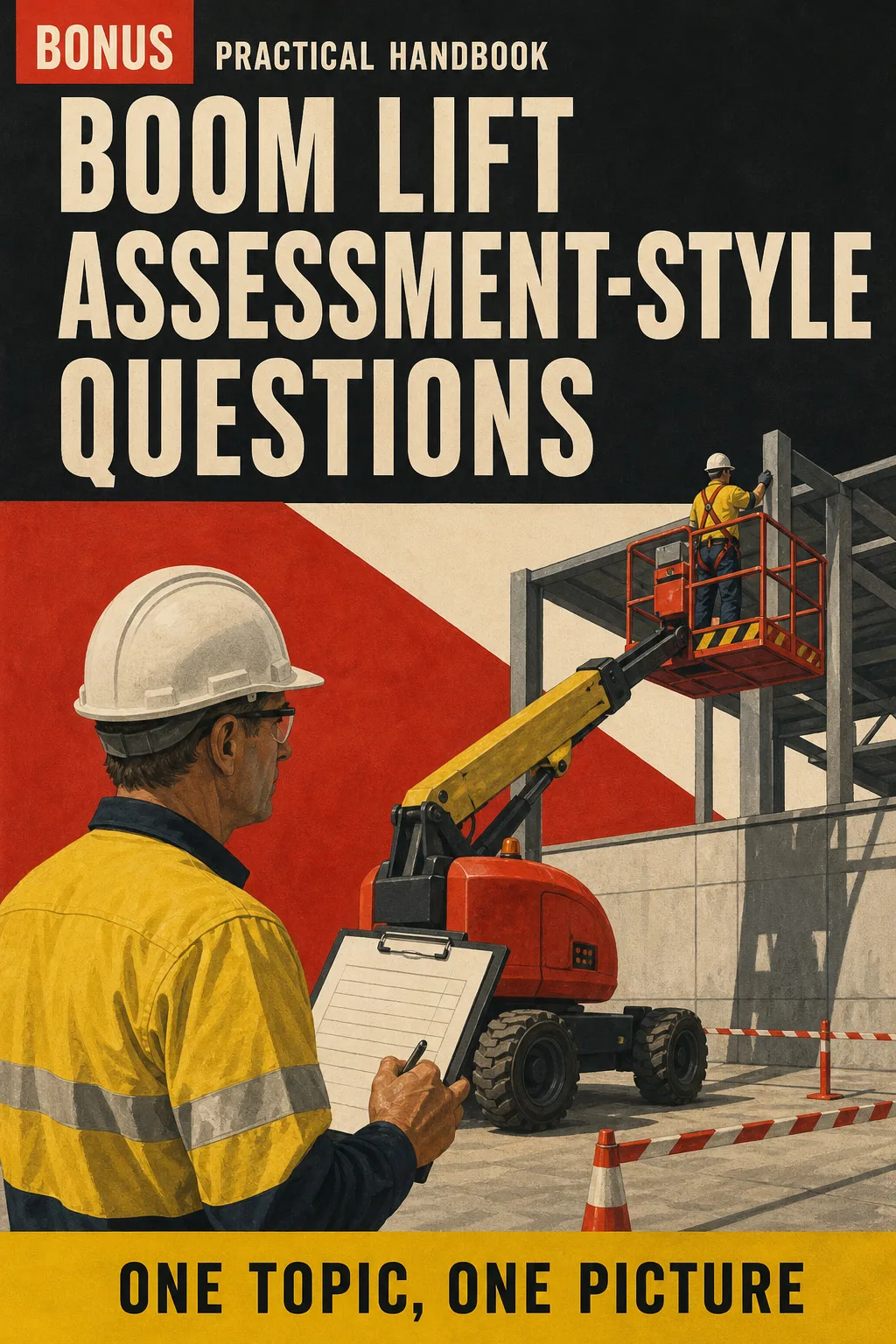
Boom Lift Assessment-Style Questions

BONUS 1: «Boom Lift Assessment-Style Questions»

Value on its own: US$ 17.90

Practise the knowledge part with questions in the style of the assessment, each answer explained and linked to its page in the book, so you find your gaps before the assessor does.

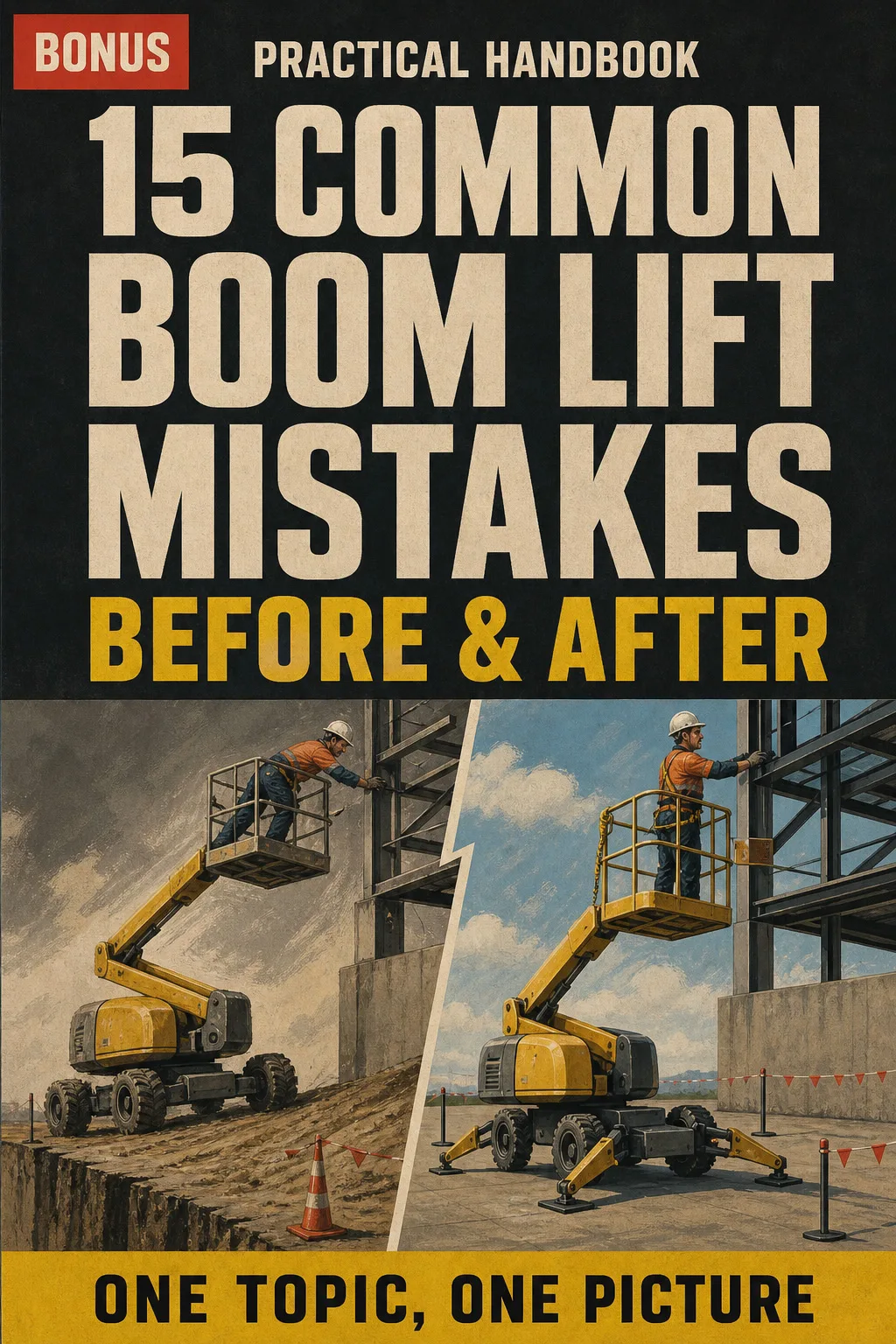
15 Common Boom Lift Mistakes: Before & After

BONUS 2: «15 Common Boom Lift Mistakes: Before & After»

Value on its own: US$ 14.90

See the 15 most frequent mistakes on a boom lift drawn side by side with the right way, from skipping a pre-start step to clipping on in the wrong spot, for a quick revision the night before.

Boom Lift (WP) Licence Illustrated with 2 Free Books

  • Boom Lift (WP) Licence Illustrated: 64 illustrated pagesUS$ 63
  • BONUS 1: Boom Lift Assessment-Style QuestionsUS$ 17.90
  • BONUS 2: 15 Common Boom Lift Mistakes: Before & AfterUS$ 14.90
  • High-resolution PDF to printIncluded
Total value US$ 95.80
YOUR PRICE:
US$ 27
You save US$ 68.80
YES, I WANT BOOM LIFT (WP) LICENCE ILLUSTRATED FOR US$ 27

📄 This is a digital PDF book sent to your email: nothing is printed or shipped.

Secure purchaseEncrypted payment30-day guarantee

PDF by email: We email you Boom Lift (WP) Licence Illustrated as a PDF, together with the two free books. It's a single payment: no installments, no extra charges.

Who This Book Is For

You're studying for your WP

You're studying for your WP

Each topic is one drawing on one page, so a half-hour after work is enough to get through a few and actually keep them.

Your RTO date is booked

Your RTO date is booked

The pre-start, the load chart and the rescue plan in a fixed order, plus assessment-style questions to find your gaps before the assessor does.

You already run a boom on site

You already run a boom on site

Print the pages you need and keep them in the ute: the pre-start map, the plate limits and the numbers to check in your state.

Everything You Get Today

US$ 95.80US$ 27
YES, I WANT BOOM LIFT (WP) LICENCE ILLUSTRATED FOR US$ 27

📄 This is a digital PDF book sent to your email: nothing is printed or shipped.

30DAYS
GUARANTEE

30-Day Guarantee

Try Boom Lift (WP) Licence Illustrated for 30 days, bonus books included.

We refund everything if the file won't open, if the book isn't what you see here, if you were charged twice or if the email doesn't arrive. Just email us.

You pay once. No subscriptions.

Frequently Asked Questions

Is it for me if I've been running boom lifts for years and only need the licence now?

Yes. It isn't a beginner's book: it puts what you already do on site into the fixed order the assessment asks for, one drawing per topic.

Where does the content come from?

It follows the national model WHS framework (Safe Work Australia's Model WHS Regulations), the unit TLILIC0005 and AS 2550.10. The WP class is the same across Australia (Victoria has its own OHS Regulations, with the same licence class), and a licence issued in one state or territory is recognised in the others. Doing it in Queensland? Your licence is issued by Workplace Health and Safety Queensland after your RTO assessment. Every distance and limit in the book is marked to check against your regulator and the machine's manual.

Is it official material?

No. It's an independent illustrated study book. It isn't issued, approved or endorsed by Safe Work Australia, any state regulator or any RTO.

Does it replace the RTO course?

No. You still need the course, the practical assessment with your RTO and the manufacturer's manual. The book doesn't give you a licence or any certificate: the licence comes from your state regulator once you pass the RTO assessment. The book helps you study and revise around them.

Are the practice questions the ones in the assessment?

No. The assessment-style questions are written for this book. Each answer is explained and linked to its page.

When and how does it arrive?

As a PDF by email, to the address you enter at checkout. The 2 bonus books come the same way.

Do I have to pay every month?

No. It's a one-off payment, no subscription.

Can I have it on paper?

Yes. The PDF is made to print, at home or at a print shop, so you can keep it in the ute.

How does the refund work?

You have 30 days. We refund everything if the file won't open, if the book isn't what you see on this page, if you were charged twice or if the email doesn't arrive: just email us.

Before You Close This Page

No more rereading the manual with nothing sticking.

The pre-start is drawn on one page: you see it and you've got it.

You walk into the assessment knowing where everything is.

Drawings make studying faster.

The book is right below.

One-time payment: US$ 27 · Guarantee: 30 days · PDF by email

YES, I WANT BOOM LIFT (WP) LICENCE ILLUSTRATED FOR US$ 27

📄 This is a digital PDF book sent to your email: nothing is printed or shipped.